Assessment · Two days · Continuous training · KPIs
Concrete AI trainingto multiply theproductivity of your team.
600+
key users trained
65+
partner companies









The method
Our method, in four phases.
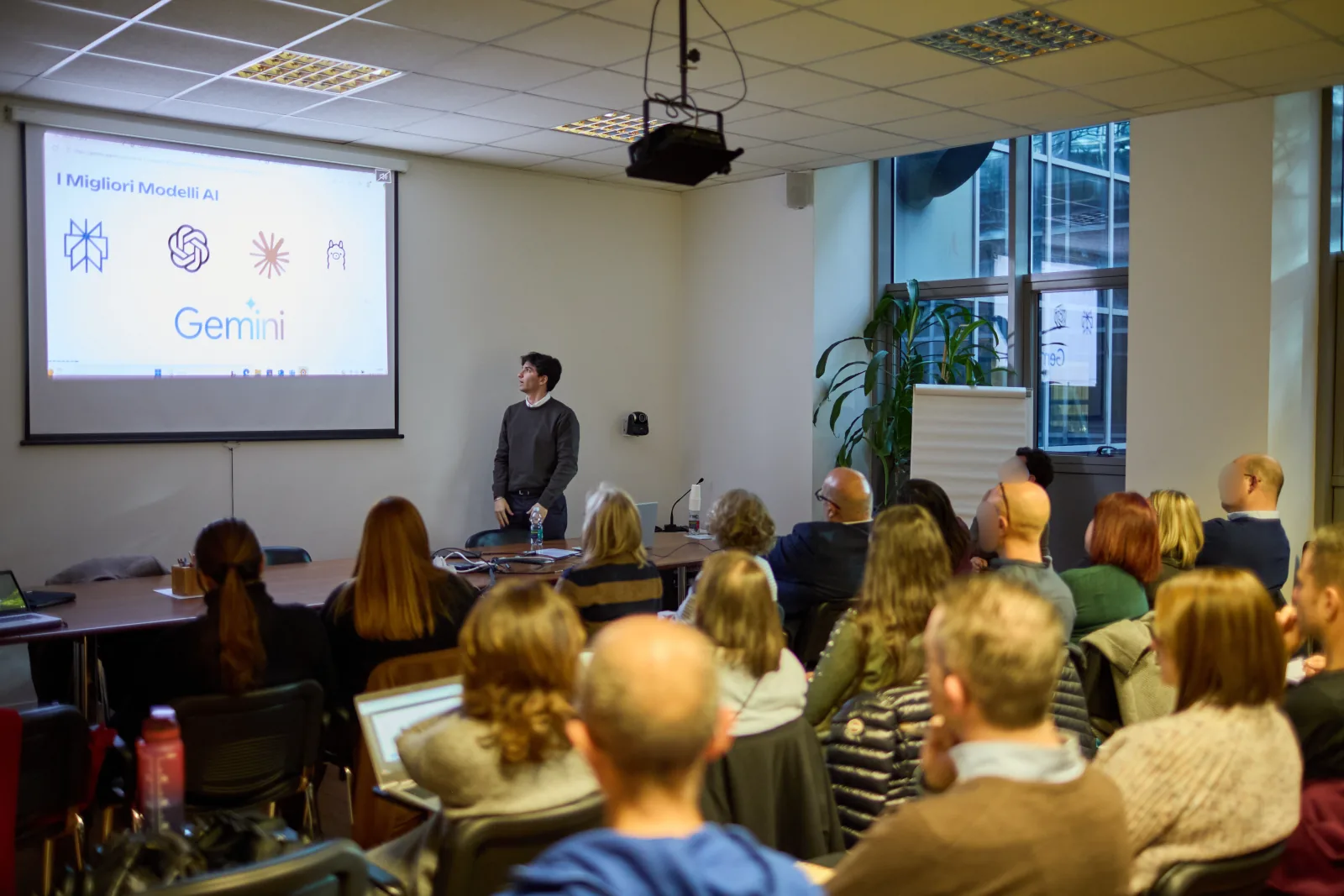
01 · The assessment
Ten minutes each. The whole team taking part in the training fills it in, two weeks before we arrive.
What it surfaces
Who is already ahead
Who will push back, and why
The real concerns
The software in daily use
The most repetitive tasks
The hours spent on those tasks
What it is for
The assessment lets us tailor the training to your company.
The main objections surface, and we already know how to defuse them. The bottlenecks surface, and we clear them in the room. And it is the basis for calculating the ROI: after the training we look at which processes the team automated, and the difference between the hours before and after is the return.
The answers also produce a personalised template for each person, built on their specific work, which we hand to them in the room.
Free AI assessment
Find out where your company stands with AI, and what the next steps are.
Eight questions, three minutes. You get the real maturity level of your company, the hours lost every year to repetitive work, which software to connect first and a 90-day plan.
02 · The two days
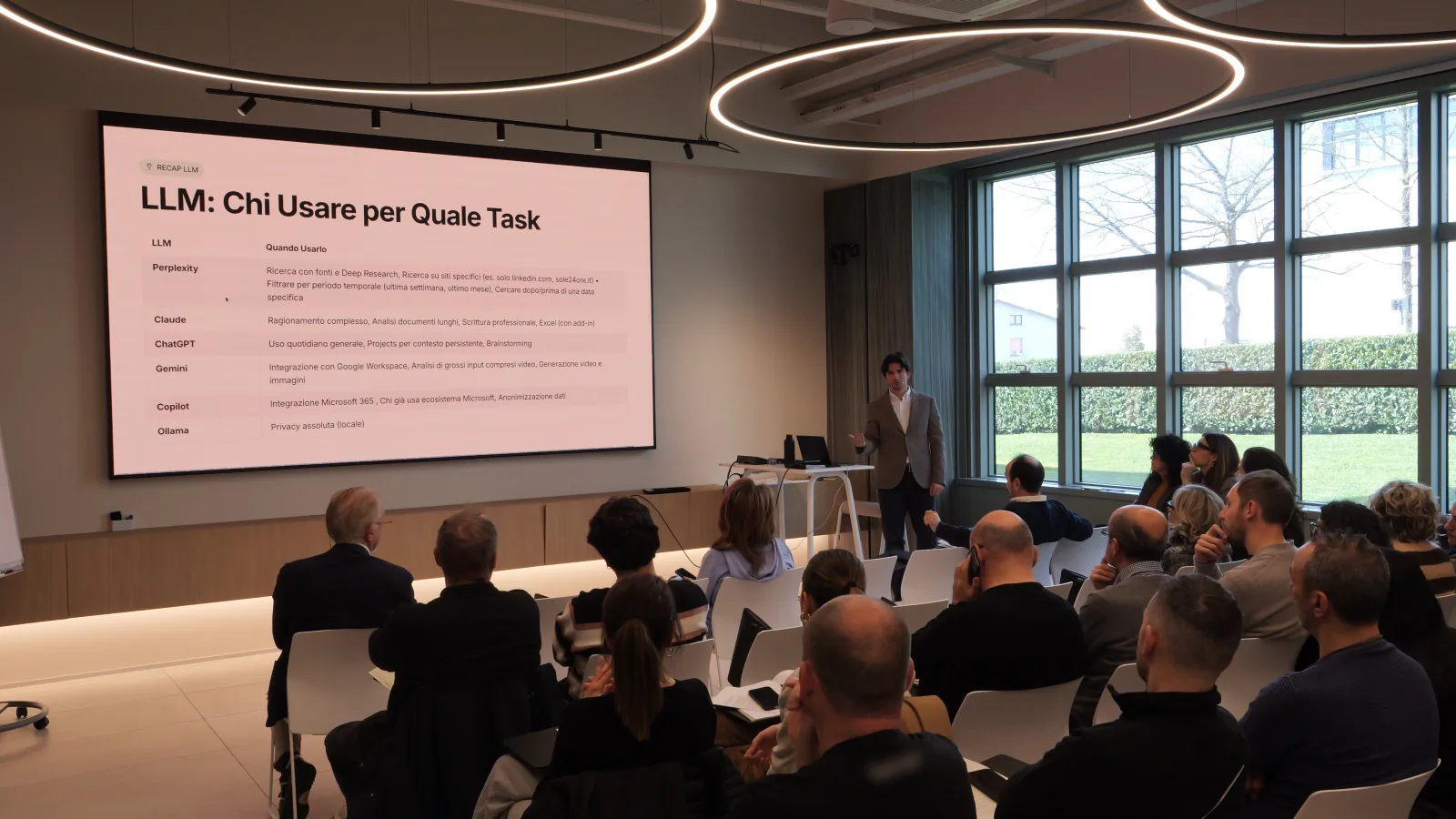
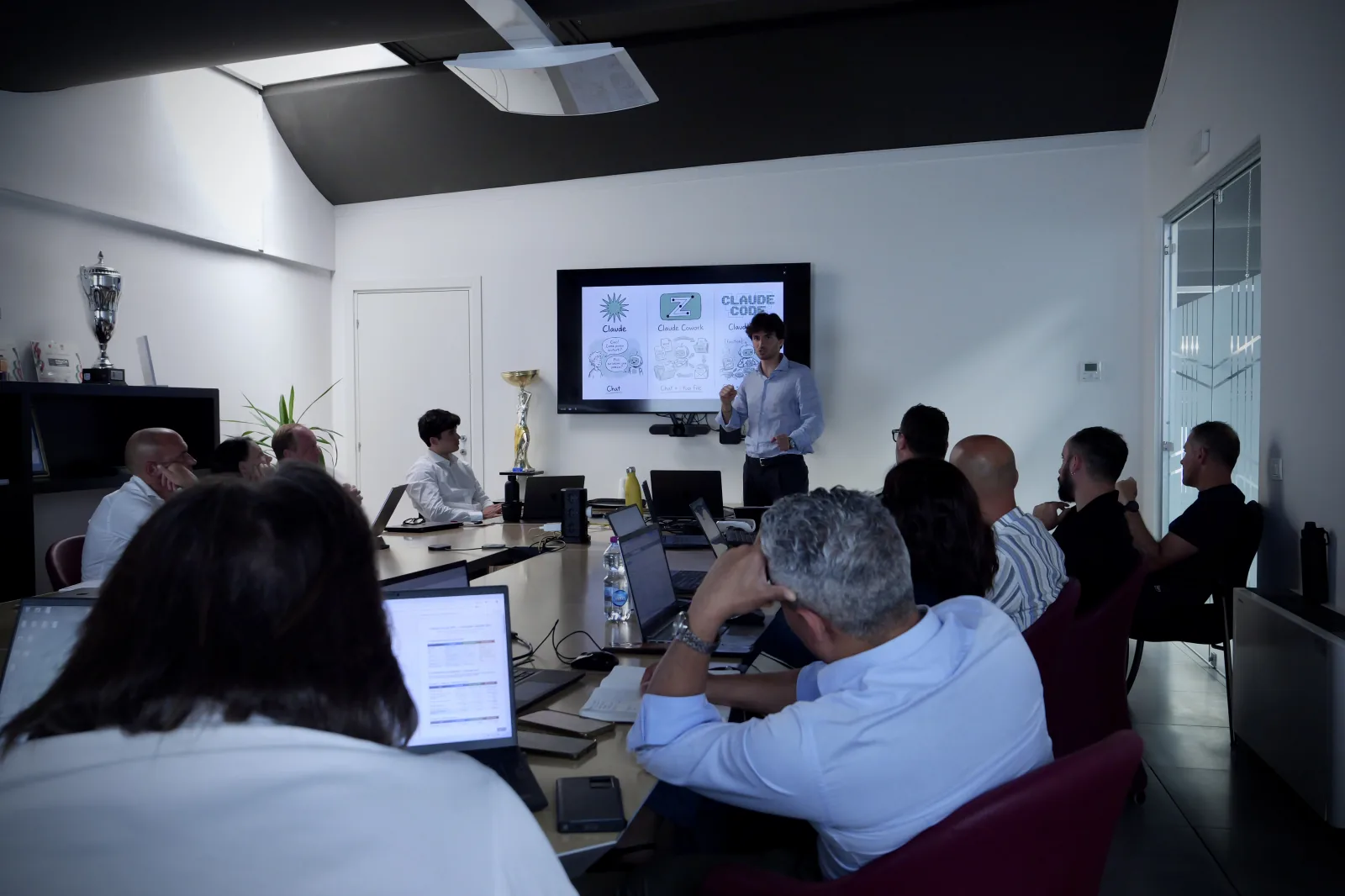
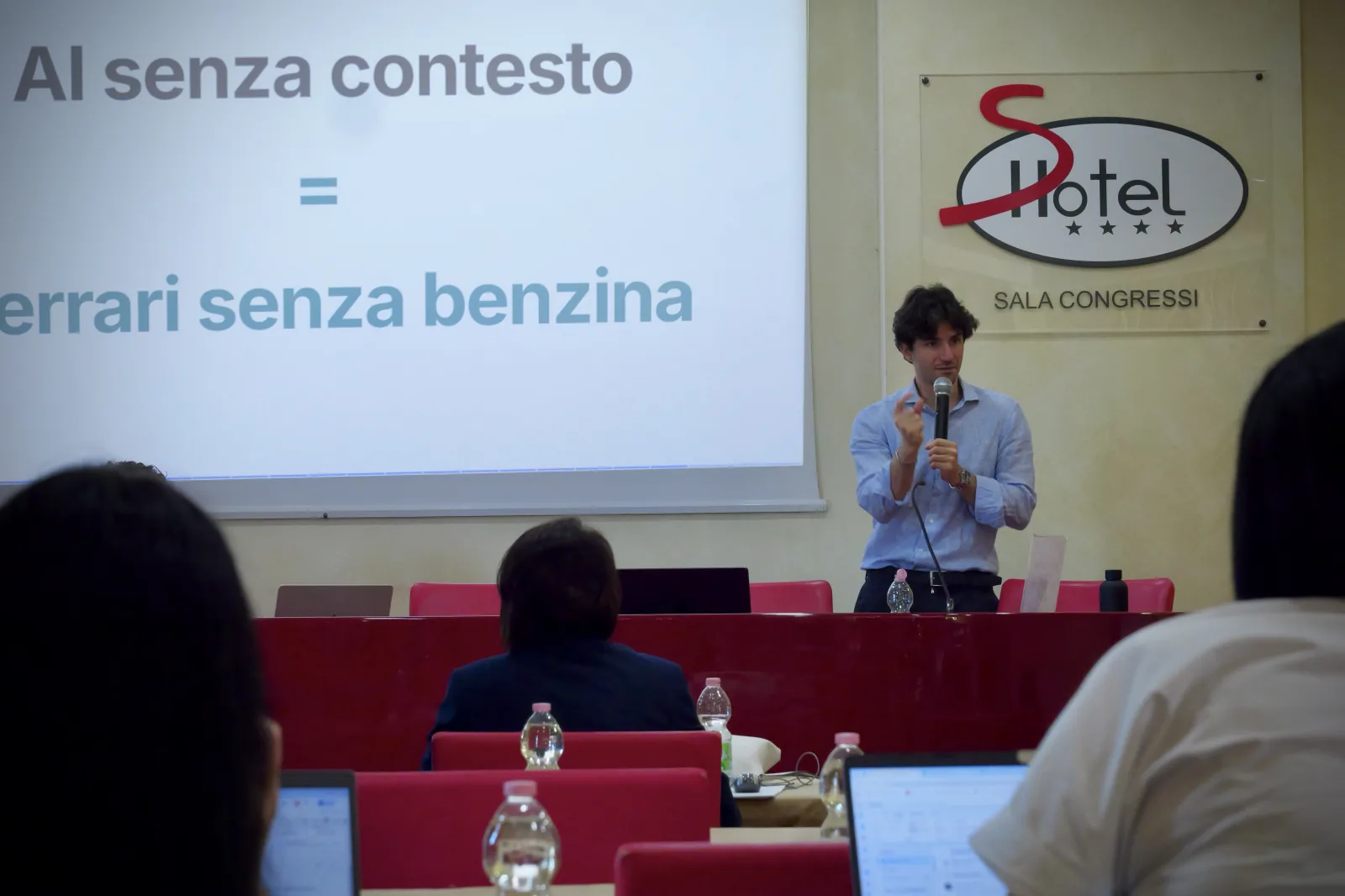
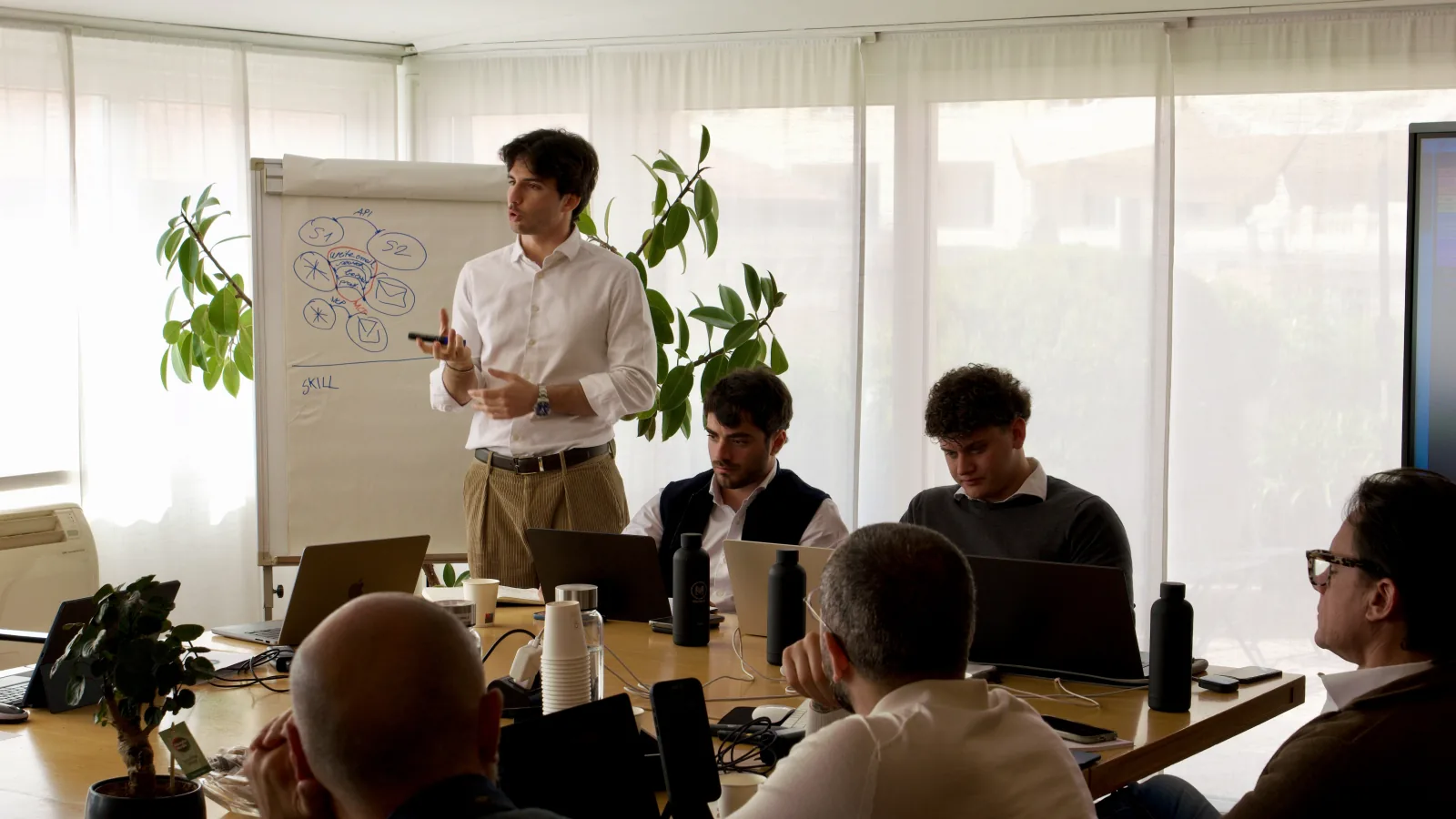
Two full days at your offices, everyone in front of their own computer.
Our philosophy is simple: 90% of the training has to happen by doing and by automating repetitive tasks, not in front of slides.
The second brain
Everyone builds their own digital second brain: who they are, what they do, which software they work on, what their objectives are, how they write.
The automations
We start again from the repetitive tasks written down in the assessment. The goal is to automate them by building skills, workflows and AI agents.
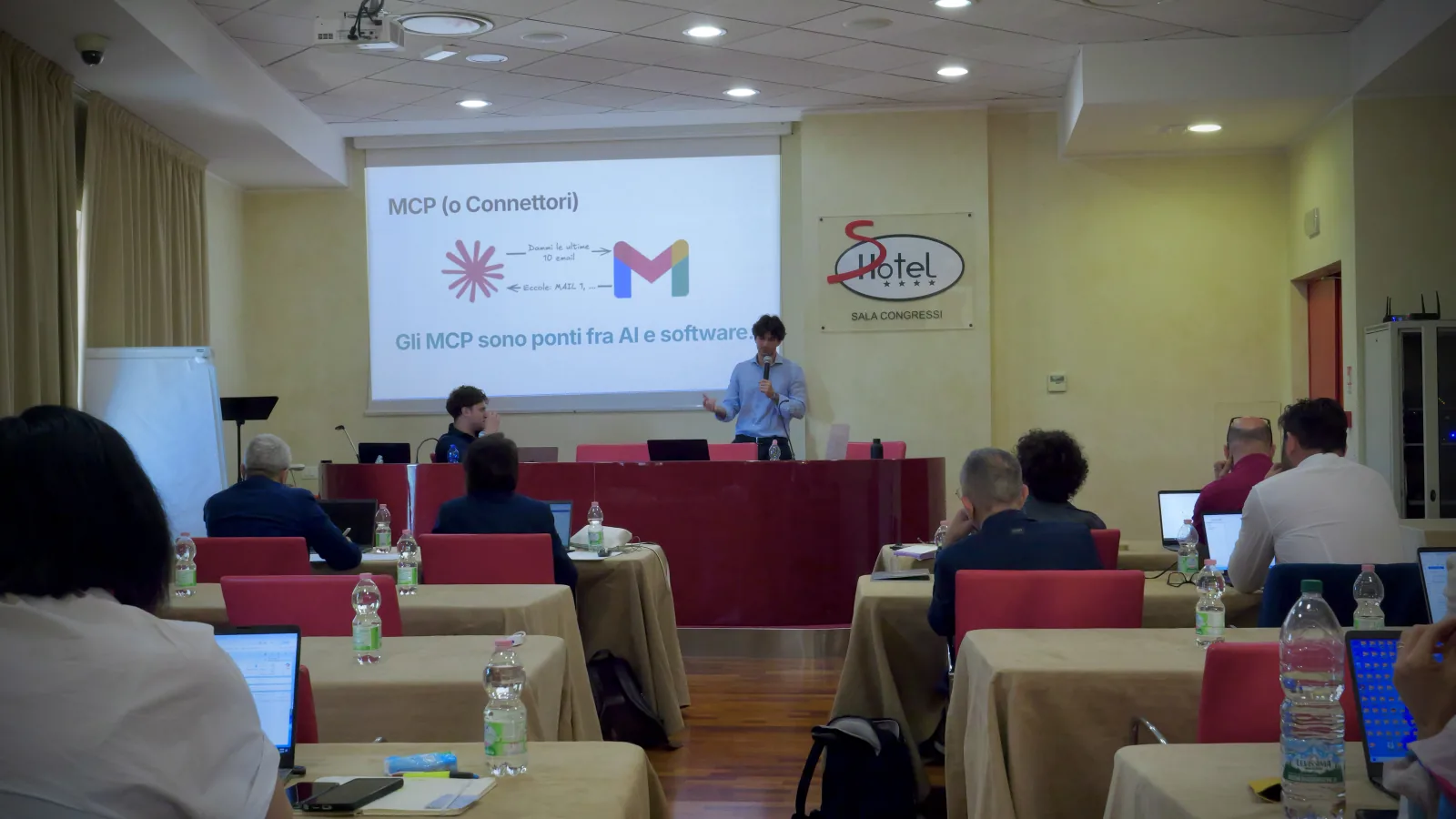
AI without context is a Ferrari with no fuel.
03 · Continuous training
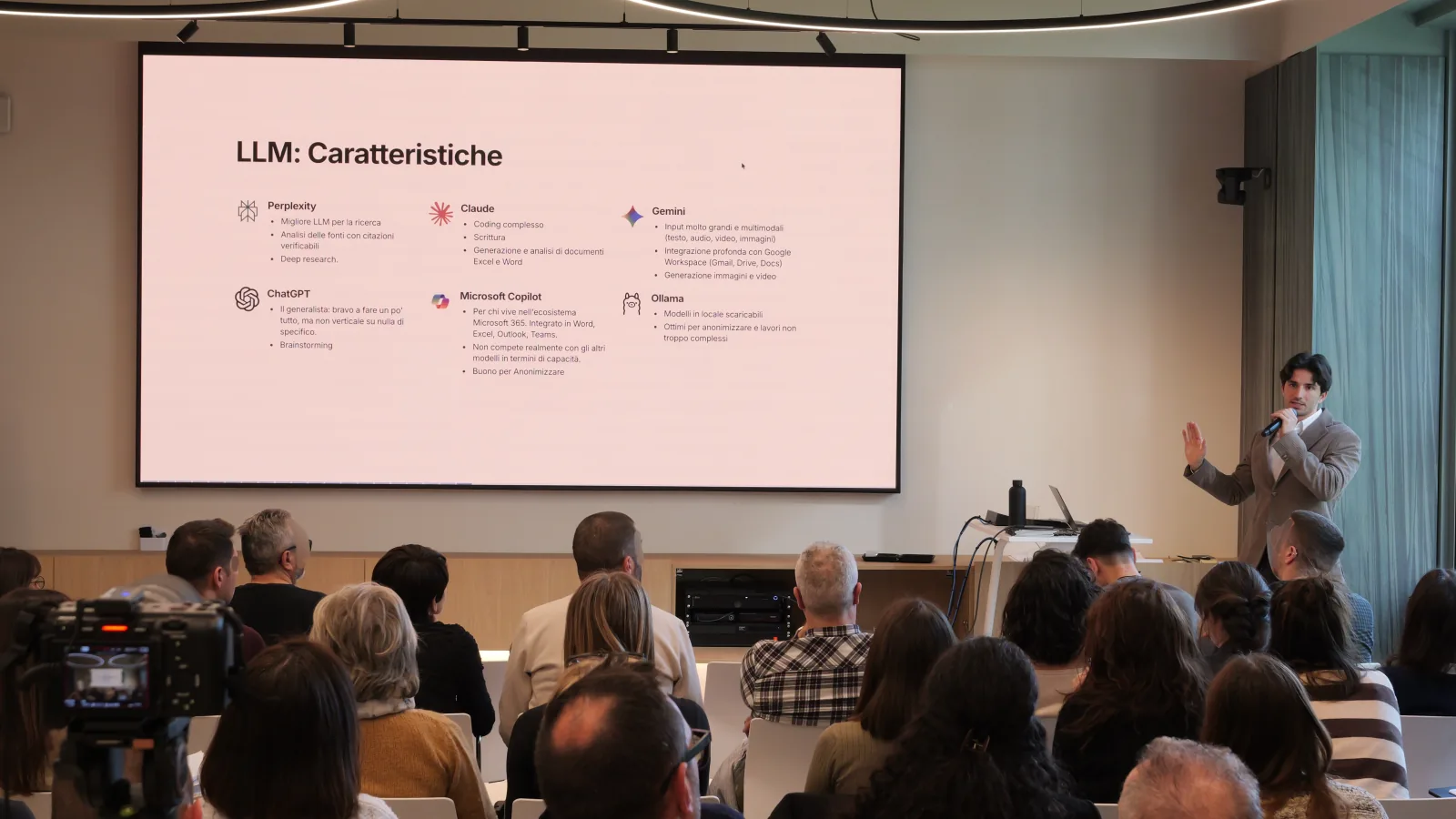
The two days make the team operational from the following Monday. It is the months afterwards that decide whether the company changes or goes back to how it was.
Two days of training are not enough, and it would be dishonest to tell you otherwise.
Asynchronous support
The courses on our platform, to follow when you need them and to watch again when the tool changes.
Personalised coaching
Paths built on the team: one for the people pulling adoption along, another for those who fell behind.
04 · The KPIs
Three weeks later we run another assessment and measure how the team is really using AI.
The second assessment counts how many processes have been automated and by whom. Against the starting number it gives the hours saved per team member.
What the monitoring gives you
Who needs help
We see it before they give up, not at the end of the path.
Who is using it best
They are the AI champions the adoption rests on across the rest of the company.
The ROI, on real data
The hours saved against the starting ones, person by person.
On those numbers we build a follow-up path tailored to your team.
Training is not measured in certificates.
It is measured in how much work the team stops doing by hand, and in how much more it gets done.
Want to know which phase your company would start from? We will tell you in thirty minutes.
Book a callCompared with a
generic AI course.
It is not a difference in syllabus. It is a difference in what is still there on the Monday after.
Slides and theory, with examples taken from other companies
Two days at the keyboard, everyone on their own files
No analysis before walking into the room
An assessment of the whole team two weeks earlier
The same programme for everyone, whatever the role and the level
A template built on each single employee’s results, a different one for each person
What is left at the end are concepts to remember
What is left is each person’s second brain and automations that run
Nobody checks that anything was actually built
At the end of the second day we check what each person built
Measured with a satisfaction questionnaire
Measured on hours a week, before and after
It ends with the last slide
It continues with personalised coaching and recorded courses
On the investment
Training can often be part funded.
For many companies a meaningful share of the cost is covered. The arithmetic you are doing changes quite a lot.
Inter-professional funds
For companies enrolled in one
Training vouchers
Where they are active locally
Regional grants
Open in rotation, they change over time
It is not automatic and it does not apply to everyone: it depends on your legal form, on the fund you are enrolled in and on what is open at that moment.
We do not handle the paperwork and we do not promise percentages. In a call we tell you within ten minutes whether your case qualifies and who to contact.
Other training paths
The two days are the complete path. If you want to start smaller, you can.
Claude Code + Cowork course
The full recorded course, to follow whenever you want. The same order in which we work in the room. The course is in Italian.
Mastermind
One day at our offices in Rome, eight selected seats. You leave with your own second brain working, built by you with our engineers alongside. From there a coaching path starts, to bring it to the rest of the team and train them too.
Coaching, 1-1 and group
A guided path that enables you and raises the level of your AI skills. You are guided by engineers who have put AI solutions into production for the companies we work with.
Testimonials
A few words from our clients
The interviews and the quotes are in Italian, the language they were recorded in.
Luigi Barbato
“Quello che avrebbe richiesto sei mesi di sviluppo e 40 mila euro, l'abbiamo fatto in poche settimane.”
Luigi Barbato
CEO and Founder, Better Bookings
Filippo Rizzinelli
“Oggi ho una knowledge base accessibile istantaneamente che unisce le informazioni di più software.”
Filippo Rizzinelli
Chief Operating Officer, Open Network
Domenico Bilotta
“Ho utilizzato il Brain per creare applicazioni che hanno semplificato la vita del management di una società molto complessa.”
Domenico Bilotta
Managing Director, Investire SGR
Roberto D'Amico
“Con il Company Brain tengo tutti i progetti sotto controllo, con risultati decisamente superiori.”
Roberto D'Amico
Head of Innovation, Gruppo GSP
Tommaso Piretti
“Ho automatizzato gran parte della produzione contenuti, dalla newsletter fino a LinkedIn: mi ha risparmiato tantissimo tempo.”
Tommaso Piretti
Founder, Performance Boutique
Giorgio Ghisalberti
“Follia. Raramente ricordo una formazione potente come questa.”
Giorgio Ghisalberti
Founder and CEO, OTO Agency
Frequently asked questions
It is not just two days: the path has three moments and it starts before we meet. Two weeks ahead each person fills in a ten-minute assessment, and from it we know who already uses AI and who does not, which software you really use and how many hours a week go into repetitive work: on those answers we build the room and a different template for each person. Then come the two days at your offices, at the keyboard and everyone on their own files: on day 1 each person builds their second brain connected to their software, on day 2 they automate the repetitive tasks they declared. After the days the path continues: personalised coaching for the people pulling adoption along, recorded courses for everyone, and two or three weeks later the same assessment run again to count the hours recovered.
Two days, which can be spread across three half days if stopping the team for two days in a row is a problem. They are preceded by an assessment the team fills in two weeks earlier, ten minutes each, and followed by continuous monitoring. On top of that the team gets access to recorded material to follow when they have more time.
Each person leaves with their own second brain working and with at least one automation running on their inbox and their files. The second brain is a folder on the computer, not a course on a tool: the same folder keeps working even if the leading model changes.
No, and none of your people will write a line of code. In the room at Truck Italia we had the CEO, the general manager, the CFO and the heads of eight sites: not one technical person. The initial assessment calibrates the content on each person’s real level and our engineers work alongside every participant.
Because it is not a slide course. Slides take about an hour, then you build. The room is calibrated on an assessment filled in beforehand, each person has a template built on their own results, and the second day is entirely dedicated to building automations on real work.
In the initial assessment, for each person, the repetitive tasks and the hours a week spent on them are already written down. Two or three weeks after the days we run the same count: same people, same tasks, same hours. The difference between the two columns is the return. Not a satisfaction questionnaire and not a certificate.
Often yes, at least in part. Inter-professional funds, vouchers and regional grants cover AI training paths, and for many companies the investment drops considerably. In a call we check together which instruments are available for your situation and we support you through the process.
During the training sensitive data does not enter at all: we work on Claude Team without uploading confidential documents, and that plan does not train models on the organisation’s content. Only in a later phase, if it makes sense, do we build the Company Brain on European infrastructure in the company’s tenant and with its keys. Governance and privacy notices are handled by a partner law firm.
Continuous training, which is the phase where adoption either consolidates or gets lost. In every company three or four people out of ten come out of the two days wanting to go further: those are the ones we work with, through personalised coaching and the recorded courses. Anyone who needs hands as well as guidance moves to Engineering as a Service.
The size of the group is defined during the assessment, based on the company’s processes and structure. We typically work with complete teams, because each person builds their own second brain: the format adapts to whoever actually works inside the processes involved.
It is the objection we hear most often. The two days can be spread across three half days over two weeks, if stopping everyone together is a problem. Anyone who misses a piece catches up on the recorded material, which stays available. And the other arithmetic matters more: the hours the team loses every week to repetitive work add up to more than two days a month.
True, and we do not hide it: our channel is public. What you will not find on YouTube is the implementation on your data and your software, and a team that starts together at the same moment and gets unblocked when it stalls. YouTube gives you the information, it does not make you adopt anything. If you have the time to do it alone, do it alone.
After the assessment we build a personalised template for each person, on their software and their tasks: we start from each person’s real level, not from a lesson that is the same for everyone. People who are already ahead work on their own things, people starting from zero do not fall behind.
In this first phase no sensitive documents come in: we work on the possibilities and on the first use cases without touching the company’s information assets. With Claude Team there is SSO and admin control over connectors, so no tools used on the sly. The level of data goes up only afterwards, when the infrastructure is configured and logged.
That is the real risk, and it is why phase three exists. At the end of the two days three or four people out of ten want to keep going: we work with them through personalised coaching, and the whole team has access to the recorded courses. Anyone who needs hands as well as guidance moves to Engineering as a Service.
The stories
The same method, two distant worlds: an automotive group with eight sites and a mediation body with more than fifty.
The management of a 126 million group, two days on site
In the room: the CEO, the general manager, the CFO and the heads of the eight sites. From the assessment: no declared sceptics, against the 30-35% we usually find.
Read the case studyMediation and dispute resolution, since 1998
Five families of repetitive work came out of the assessment, from the inbox repeating the same answers to documents retyped by hand into the platform. The work now continues with development.
Read the case studyThe right moment was a year ago.
The second best is now.
Thirty minutes: we tell you whether it makes sense to start from the two days or from something smaller, based on where you are now.
Book a call