AI training for 100 people and 34 AI Champions at the Port System Authority of the Sea of SardiniaThe public body governing the island's nine ports
01 · In short
From the problem to the result
The problem
In a public body the question is not how to use AI. It is what you are allowed to upload without breaking the law. Underneath sits the repeated work: about a third of the group reported over five hours on a single task.
The solution
An assessment before the room, a plenary session for 100 people on the rules and the method, four workshop days with the 34 AI Champions. Plus the masking tool we built for them.
The result
34 AI Champions with their own workspace and their own skills: agents that search for public funding calls, dashboards on their own data, a procurement register that updates itself.
02 · Who the authority is
The Port System Authority of the Sea of Sardinia is the public body that governs the island's nine ports, from Cagliari to Olbia, with its administrative headquarters in Cagliari.
The authority in six numbers
9 ports governed
6.43 million passengers in 2025
679,000 cruise passengers
286,000 TEU handled, up 36%
€780m of works under way across the port system
€157m of EU recovery funds already reported
A port authority does not only move ships. It moves paperwork: state concessions, tenders, decrees, records management, reporting on European funds. Almost all of the work people do is document work.
And those documents are full of data that cannot leave the building. That is why inside a public administration AI goes through the rules or it does not go through at all.
03 · We started from what must not be uploaded
The first thing we built for them was not a prompt. It was the list of the documents the authority actually handles, office by office, each with a colour: more than one hundred and fifty entries, which we validated with them line by line before we walked into the room.
The traffic light
Green: goes in as it is
Published acts, legislation, circulars, templates with no real data inside. Uploaded without a second thought.
Amber: masked first
Documents with names, tax codes, addresses, protocol numbers. They go in only after the masking tool.
Red: stays out
Port security, health data, tender bids before the award, live litigation. They are not uploaded, and it is not a question of tooling.
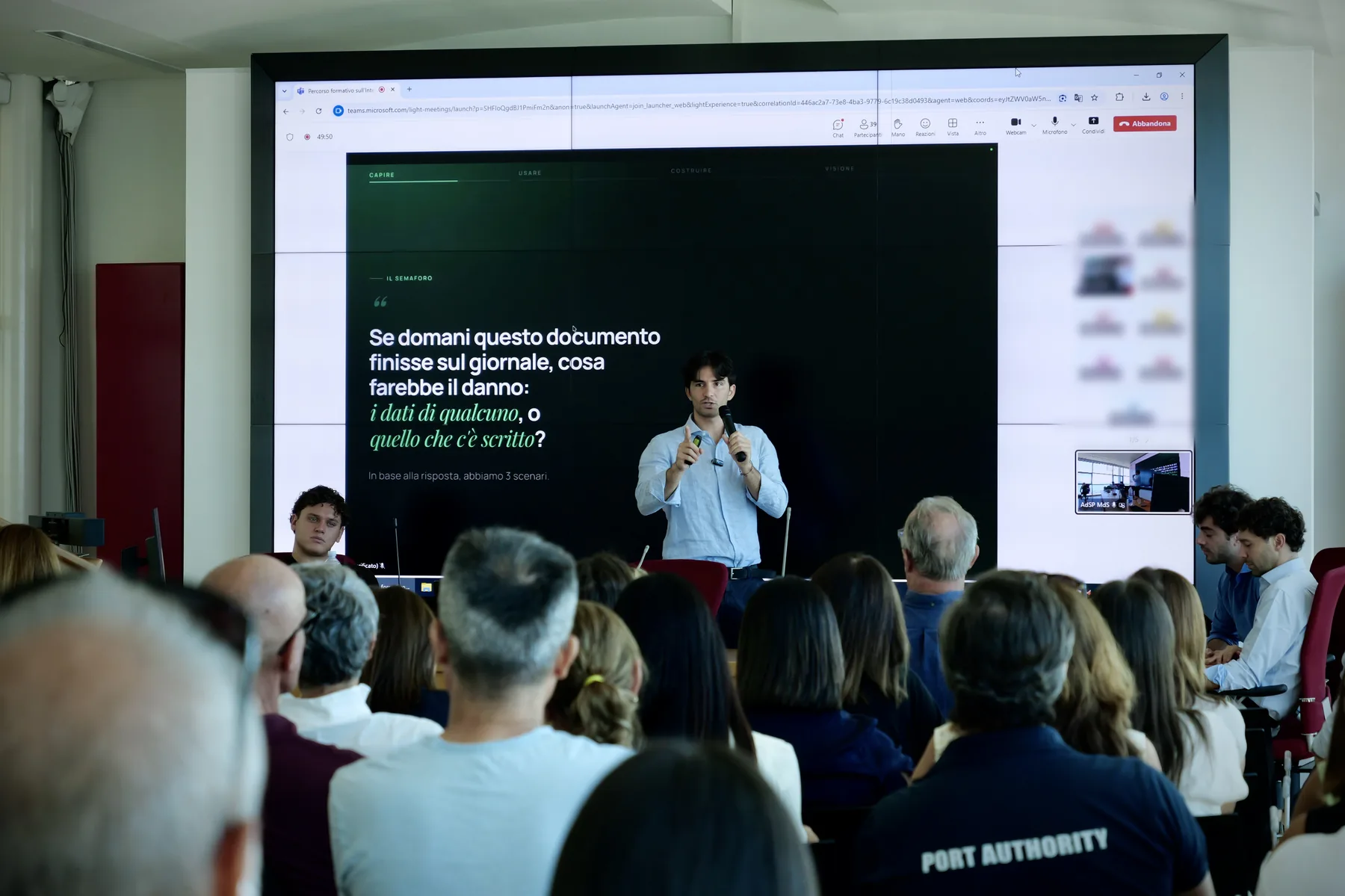
The colour is not learned by heart. It is decided with a single question: if this document ended up in tomorrow’s paper, what would do the damage, somebody’s personal data or what it actually says?
« Without that list you teach AI in general. And AI in general cannot legally be used inside a public administration. With it, every person knows before they even open their laptop what they are allowed to do with the document in their hands »
Amber goes through the masking tool
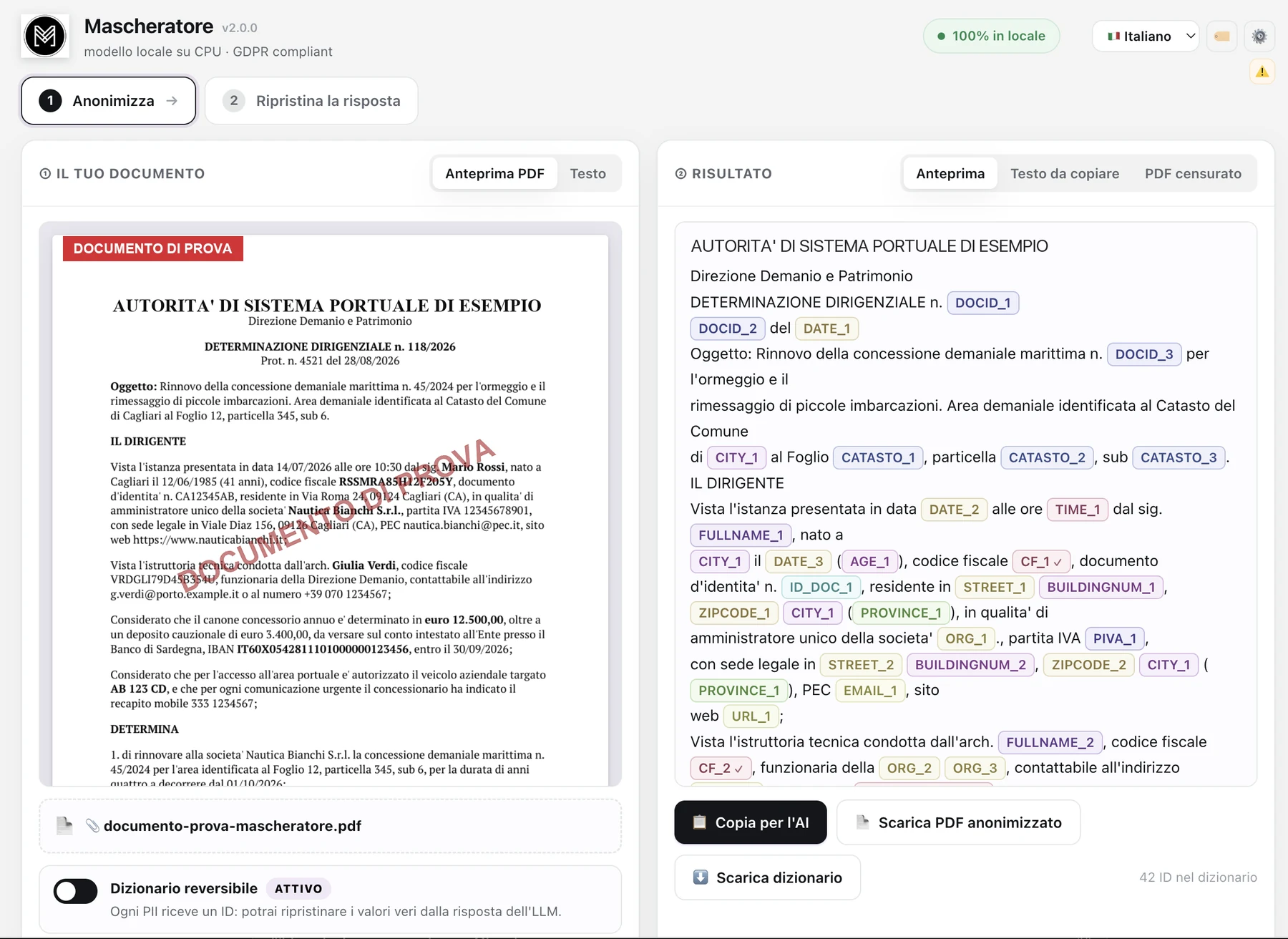
Amber is the largest slice and the one where mistakes happen: it is the everyday paperwork, full of names and tax codes. For those the authority uses the masking tool we built for them. Every personal detail is replaced with a placeholder, the masked document goes to Claude, and at the end the dictionary puts the real values back in their place.
04 · The assessment, before we walked in
As in every programme we run, before walking in we had the whole group fill in an assessment: where each person's time actually goes, task by task, and how often.
What it surfaced
Almost half the group was already ahead
They used an assistant every day. A session starting from "what is a language model" would have lost them in minutes.
The same tasks across offices that never talk
Compliance deadlines monitored by retyping data, incoming mail to sort and classify, standard documents rebuilt by swapping the recipient's details, checks on budget coverage, technical reports and letters.
05 · The plenary: 100 people, half a day
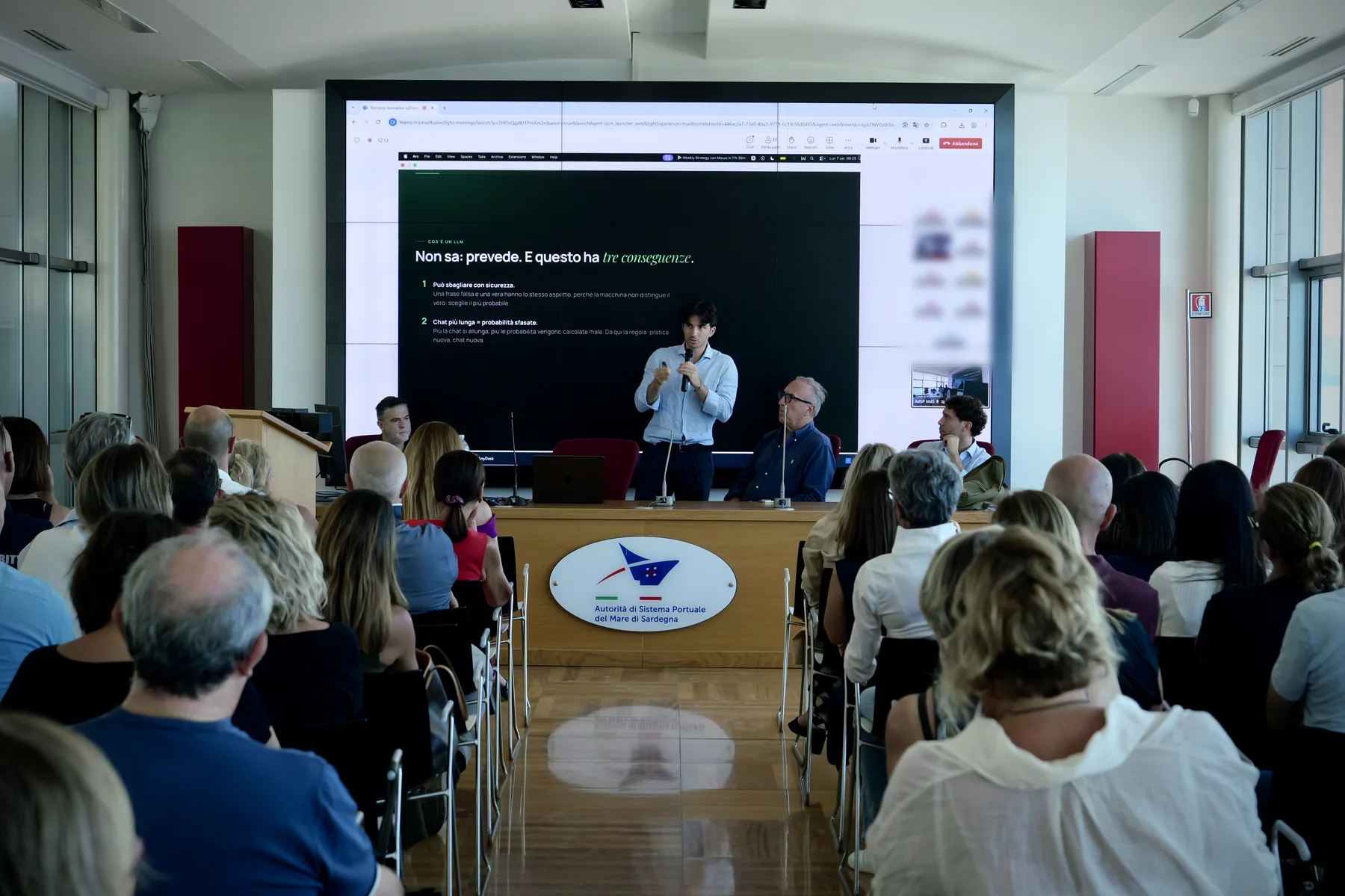
Around forty in the room in Cagliari, the rest joining from the other ports. Half a day to bring the whole authority to the same starting point, which means turning Claude from a chat into a personal assistant.
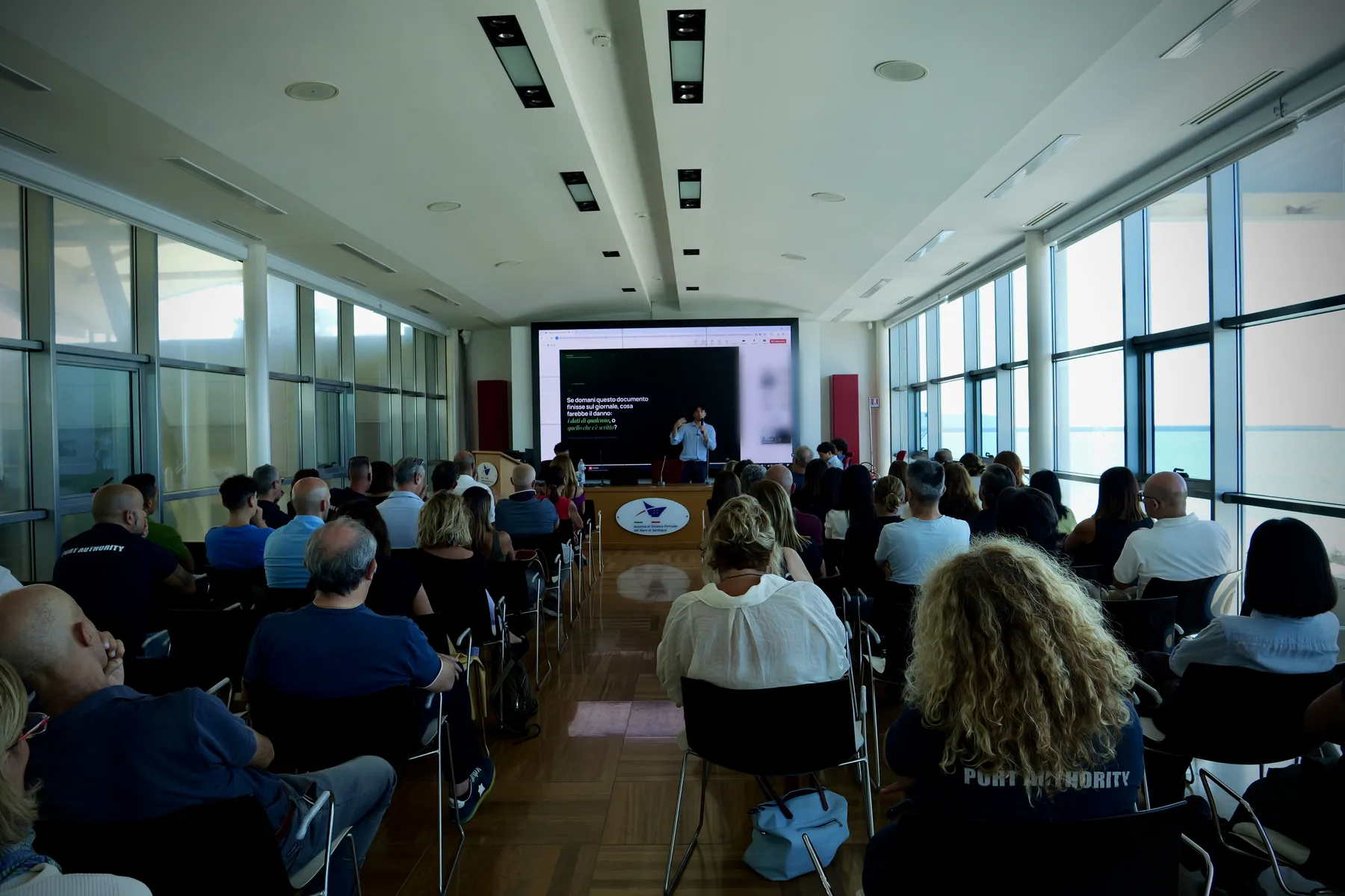
What we showed in the room
How a model really works
Why what comes out depends on what goes in.
The real risks and how to avoid them
Where whatever you paste ends up, plus the green, amber and red list with a single question to sort it.
Handling sensitive data
With the examples taken from their own documents, not from a textbook.
The EU AI Act
What is already in force, what is coming and what falls on them.
The habits of people who use AI daily
Dictating instead of typing, making it ask the questions, switching off the automatic yes, not dragging the same conversation on forever.
Claude's deep research
It goes out and searches on its own, then comes back with the sources.
The skill that interviews you before it produces anything
It asks the questions, so the gaps surface before the result instead of after it.
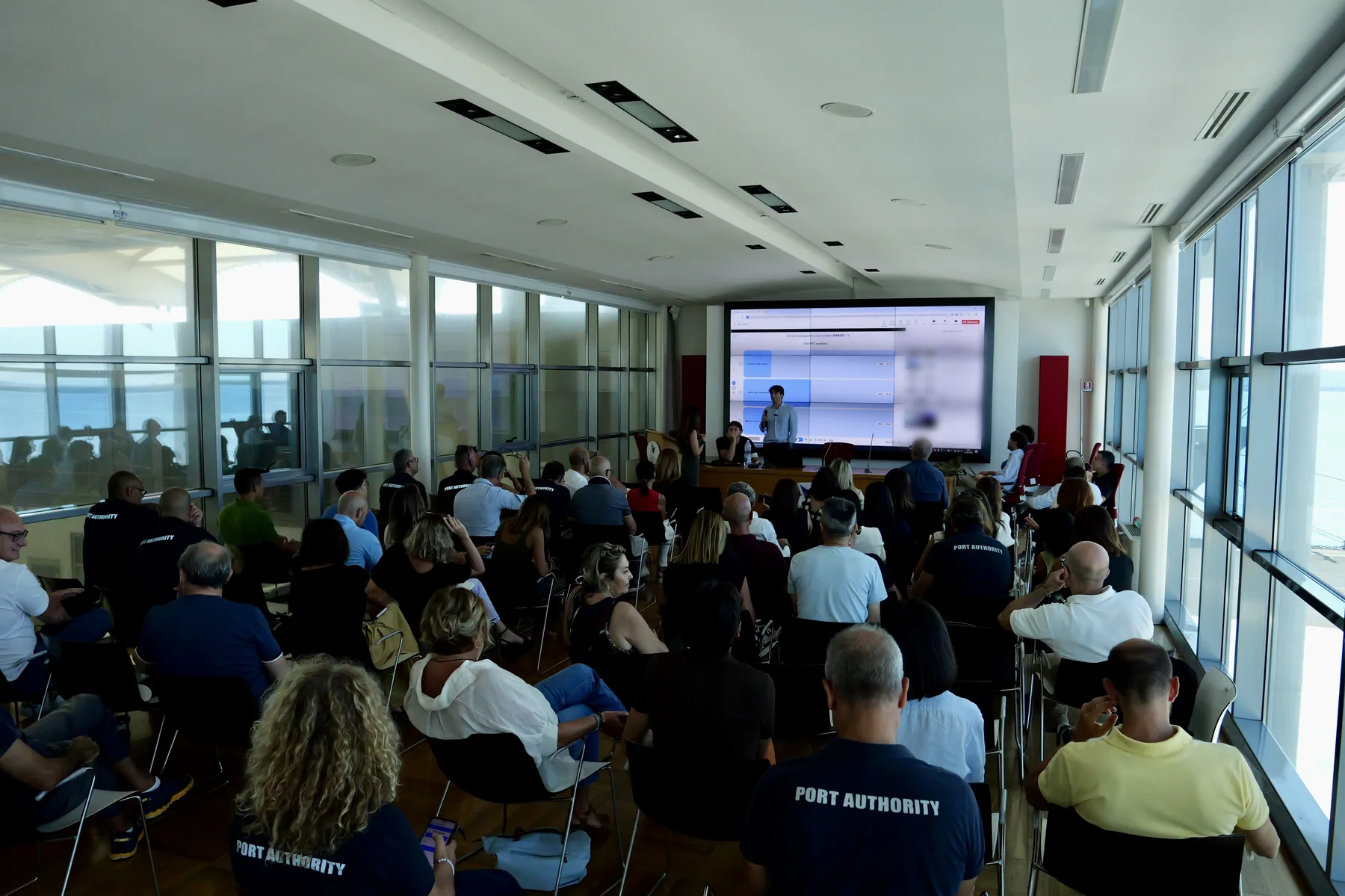
06 · Four workshop days with the AI Champions
Then we narrowed the group. 16 AI Champions for two days and another 18 for two more, picked from inside the authority's directorates: technical, administrative, operational.
This is not a class that watches. Everyone arrives with a process of their own and leaves with it working.
« The most important strategic part is putting to the test in the field what is taught in theory. A team of young people worked alongside the professionals, made them understand the potential of the system and built practical examples that made them see the opportunity. That made the difference and is still making the difference »
Alessandro Becce, Secretary General of the Port System Authority of the Sea of Sardinia
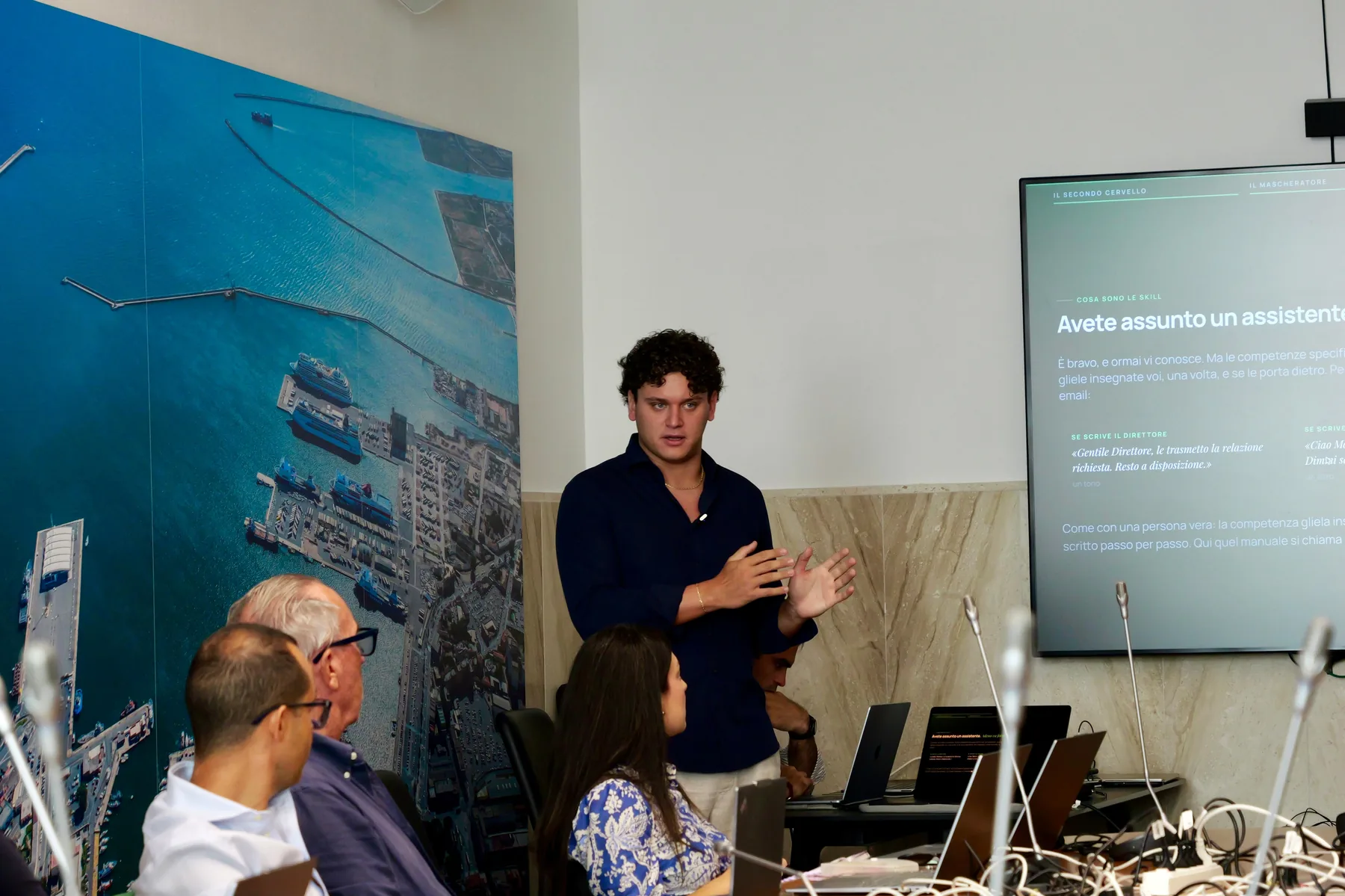
The four steps
The workspace
A second brain for each person, instead of a chat that starts from scratch every time.
The masking tool
Amber documents get masked before they are uploaded, on the authority's own machine.
The skills
One for everything that gets redone the same way. First we did it together, then it became a command.
The real process
Everyone works on their own, with their own documents, on their own computer.
07 · The masking tool, we built it ourselves
We did not buy it and we did not write it from scratch: we put it together from open-source pieces, then adapted it to the authority’s own work and installed it on their workstations.
What is inside
rizzo-pii
The detection engine and the Italian 0.3-billion-parameter model by Simone Rizzo, MIT licence. It reads tax codes, VAT numbers, IBANs and cadastral references, the language of Italian public documents, which a generic English model lets straight through.
Transformers and PyTorch
They run the model on the CPU of whoever is using it. No graphics card, no network, no API key.
PyMuPDF
It actually removes the text from the PDF instead of covering it with a black box, so the data does not come back with a copy and paste.
What we added for them
Digitally signed .p7m files
A public authority works on digitally signed decrees. The original refused the signature envelope and you had to open it by hand with a signature client: now the tool opens it on its own and works on the document inside, PDF or Word.
Word, Excel and PowerPoint
The original reads PDFs and plain text. Their work lives inside Office files, so we opened those too.
The signature box
In the signature box of a signed PDF the signer’s name and date were still extractable underneath the placeholder. Now they are gone from there too.
The document never leaves the machine and no data passes through an outside service. Once the work is done the dictionary puts the real values back, and the signed original stays untouched: that is the one that counts.
It is not a piece of artificial intelligence. It is the condition that lets a public office use AI on a real document.
08 · What they built
With their own hands, on their own processes
Agents that search for public funding calls
Dashboards to read their own data at a glance
A register of the authority's procurement that updates itself
Skills for the documents rebuilt the same way every week
The scale
100 people in the plenary, from all nine ports
34 AI Champions across four workshop days
None of these tasks was picked by us. They were on the list that came out of the assessment, written by the people who do the work.
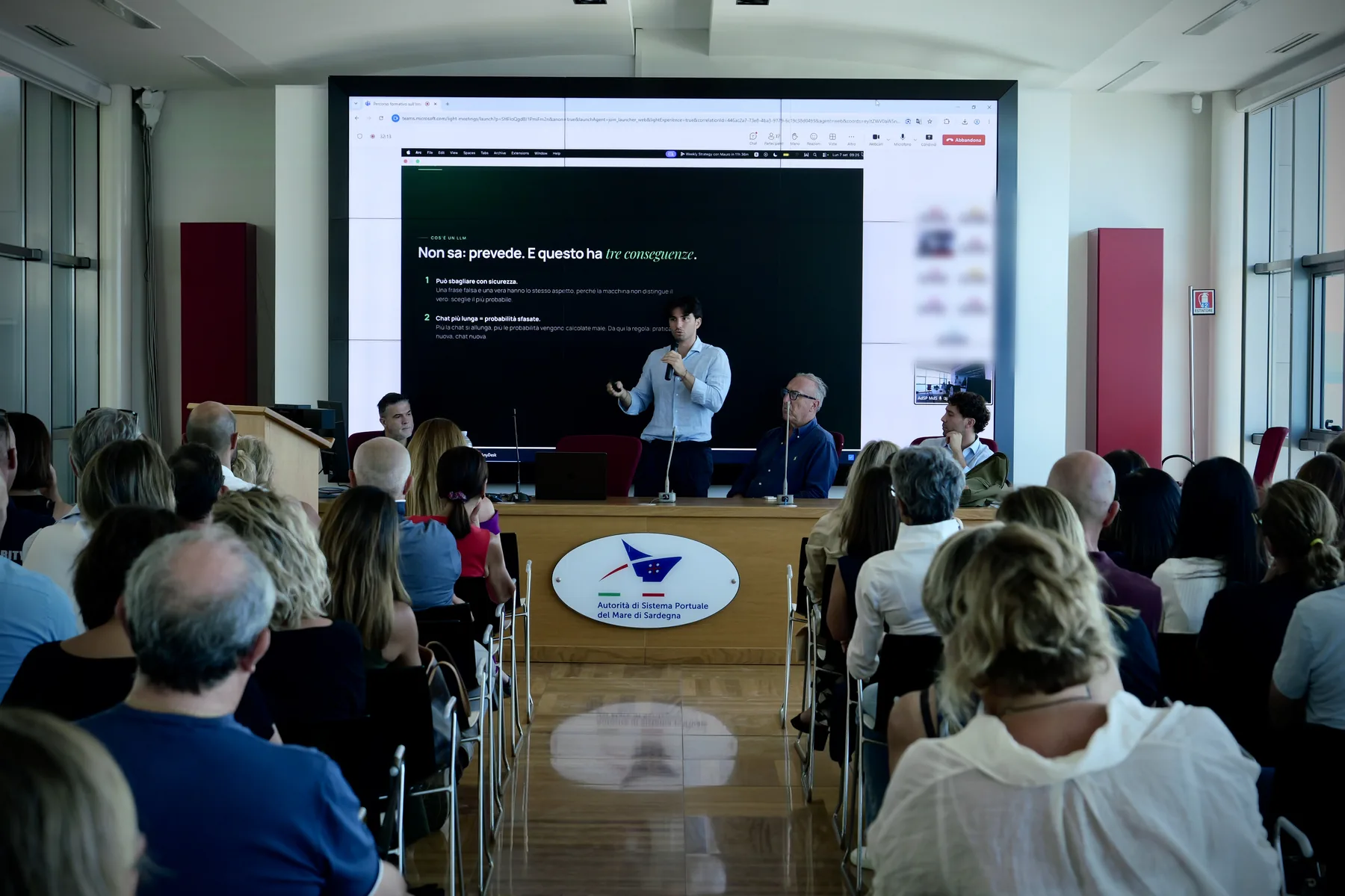
09 · How we carry on
The training does not close the work with the authority: it opens the real one. The next step is the Company Brain: a single reservoir where documents, mail and extractions from their systems come together, with search, analysis and management dashboards on top.
It stays installed and running on the authority's own infrastructure, with inference in Europe, so the data never leaves. And the AI Champions trained in these days are the people who will drive its adoption, office by office.
"Le persone si sono rese conto che questi strumenti possono migliorare la qualità della vita sul posto di lavoro. Più si va avanti e più li usano e più questa sensazione si consolida."

Want similar results for your company?
Tell us about your challenge. We'll find the right AI solution for your business together.
Let's Talk